
Embark on a journey of inner exploration with this spiritual blog. Here, we delve into the wisdom of JKYog, helping you cultivate peace, purpose, and profound well-being. Explore practical teachings, inspirational stories, and guidance to connect with your inner self and navigate life's path with clarity and joy.
The Importance of Devotion in Sadhana

Continuing with the next line of ‘Sadhana Karu Pyare’series…
ग्रन्थ पढ़ु जनि बहुत सुनु जनि, संत मत बहु प्यारे |
granth paṛhu jani bahut sunu jani, saṅt mat bahu pyāre
Jagadguru Shree Kripaluji Maharaj is asking us to engage in loving God rather than spending our time reading numerous scriptures. These scriptures mention various ways of sadhana, such as awakening the Kundalini, practising Panchagni Kriya, concentrating on the agya chakra, and so on. Moreover, in our Hindu religion, there are many scriptures. If someone wants to read them all, it will take 500 years to complete. And suppose if someone completes reading them, doubts will arise in one’s mind, “Here, it is written like this. There, it is written in another way.” So, Ved Vyas says:
श्रुतिर्विभिन्ना स्मृतयश्च भिन्ना नैको मुनिर्यस्य वचोप्रमाणम् |
धर्मस्य तत्त्वम् निहितम् गुहायाम् महाजनो येन् गतः स पन्थाः ||
śhrutirvibhinnā smṛitayaśhcha bhinnā naiko muniryasya vachopramāṇam
dharmasya tattvam nihitam guhāyām mahājano yen gataḥ sa panthāḥ
There are several scriptures. The more you read them, the more you will get confused and entangled. When you attempt to find the answer to one question from the scriptures on your own, you will end up tormented by a thousand other questions.
These days, many devotional TV channels show the discourses of several different saints. The viewer gets confused as everybody tells different ways to practice devotion. One saint says to read Hanuman Chalisa, and the other says to perform austerities. The person wonders and thinks about what to do and ends up doing a little bit of this and a little bit of that, a little he learns wrongly, and a little he forgets. Altogether, it becomes a mess and even more confusing. Your goal cannot be realized in this way.
For many years, innumerable ways and means have been propounded by innumerable sages and Saints. We should firmly believe that the devotion we are practising, taught by our Guru, is correct and will lead to God-realization one day. A firm decision should be made that God will be attainable only through this path. There is no need for any other path. So, what is the easiest way of attaining God? The path is bhakti marg, i.e. the path of devotion or love. God will be attained only by love.
Ved Vyas ji wrote eighteen Puranas, which contain four hundred thousand verses. He also wrote the Mahabharat, which consists of one hundred thousand verses. Each Purana contains eight lakh shlokas. He embedded the Geeta in the Mahabharat. However, after writing so many scriptures, Ved Vyas thought, “What is the summary of all these scriptures? All humans should learn something. Nobody has the time and lifespan of 500 years to read all these scriptures.” So, Ved Vyas said:
आलोड्य सर्वशास्त्राणि विचार्य च पुनः पुनः ।
इदमेकं सुनिष्पन्नं ध्येयो नारायणः हरिः ॥
āloḍya sarvaśhāstrāṇi vichaārya cha punaḥ punaḥ
idamekaṁ suniṣhpannaṁ dhyeyo nārāyaṇo hariḥ
“I have churned all the scriptures several times and contemplated upon them. I have come to the conclusion that one should love God.”
Kabir ji also said the same thing in his simple language way:
पोथी पढ़ि-पढ़ि जग मुआ, पंडित भया न कोय,
ढाई अक्षर प्रेम का, पढ़े सो पंडित होय।
pothi paḍi paḍi jag muā, pandit huā na koi
ḍhāi akśhar prem ke paḍe so pandit hoye
In this world, nobody has become a scholar by reading these scriptures. The one who has learned to love God is the real scholar. Until today, all Saints who descended in this world have said only one thing: to love God. But, when those Saints left this world, individuals under the influence of Maya forgot this philosophy. Everybody started to practice the path of karma kand (to perform Vedic ritualistic actions/duties prescribed by the scriptures). We start fighting over simple issues like, “You are not wearing the tilak correctly. You are committing a sin.”
Another person says, “You are not wearing the kanthi mala (beads necklace) around your neck. It is wrong.” In this way, we souls are tied up in the physical and ceremonial aspects of karma kand and have completely ignored the main philosophy: love God.
When a Mahapurush descends into this world, he advises only one thing: love God. When they leave this world, we fight over external rules and forget the essence of his teachings.
Now, one can say that if God is attainable only by love, then why are there so many different difficult paths to realize God? For example, awakening the Kundalini, practising panchagni kriya, concentrating on the agya chakra, etc.
Ved Vyas ji answers this question and says:
तावत् कर्माणि कुर्वीत न निर्विद्येत यावता ।
मत्कथाश्रवणादौ वा श्रद्धा यावन्न जायते ॥
tāvat karmāṇi kurvīt na nirvidyet yāvatāmat kathā
śhravaṇādou vā śhraddhā yāvan na jāyate
“Undoubtedly, we can attain God only through devotion, but people don’t have faith in devotion.” People are unable to appreciate the beauty of the simple path. If someone asks, “How do you practice pranayam?” “See, first make the nasarya mudra, and then while keeping your right nostril closed, inhale from the left nostril and then, while keeping your left nostril closed, inhale from the right nostril.” You will probably comment, “This saint does not know anything.” Instead, if I complicate things, “I will tell you the correct method of practising pranayama. First, twist your right hand from the back, touch your right nostril, and then twist your left hand from the front. With fourth and fifth fingers, close the nostrils and inhale and exhale.” On hearing this, people will say, “Yes, this is a great method of doing pranayam.”
It shows that the intellect does not appreciate the importance of the easy way. For example, why do people climb mountains and walk miles in a queue to visit Tirupati Balaji Temple and Vaishno Devi Temple? They say, “It is a temple of Lord Vishnuji.” “So, don’t you also have Lord Vishnuji’s temple in your city?” “Yes, we have a temple. But that Vishnuji is small. And the Vishnuji at Tirupati is big. That Vishnuji’s is placed on a mountain and this Vishnu ji is on sea level. So, that Vishnuji must be a more powerful Vishnuji compared to the one near my house!”
People visit the Charm Dham (Hindus’ four sacred pilgrimage sites). Shree Kripaluji Maharaj says:
चारो धाम काहे करे गोविन्द राधे
तेरा हरि तेरे उर बैठा है बता दे
chāro dhām kāhe kare govind radhe
terā hari tere ur baiṭhā hai bata de
“You visit the four pilgrimage sites looking for God while He resides in your hearts.” Our intellect does not accept this fact. Unless one visits these places, they will not begin having any devotional feelings and believe they are connected with God. Similarly, the Vedas have given various complex paths for people who cannot have faith that God can be attained merely by devotion.
However, first and foremost, we must understand that the essence of all the scriptures is only one thing, i.e., to love God. There will be no use in reading so many scriptures. It will just lead to confusion: “This book says like this; that scripture says other things.” This will result in doubts, which will be obstacles in your devotion. Understand the philosophy from the Guru thoroughly and then implement it practically. This is what Shree Kripaluji Maharaj explains in this line.
Spiritual Journey Begins with a Leap of Faith

Belief in God is not a natural process that we as human beings just follow. We have to exercise our free will and actively make a decision to have faith in God.
Date: 5th May 2017
In the field of material science, we begin an experiment with a hypothesis and conclude with a verified result. But in the field of spiritual science, we begin the practice with a leap of faith which results in the direct perception of God.
The Bhakti Rasāmṛit Sindhu (1.4.15) states:
आदौ श्रद्धा ततः साधु-सङ्गो’थ भजन-क्रिया
ādau śhraddhā tataḥ sādhusaṅgo ’tha bhajanakriyā
The first step in the path to God-Realization is to have faith. Then one begins participating in satsaṅg (spiritual programs). This leads to the personal practice of devotion.
Often people say that they are only willing to believe in what they can directly perceive, and since there is no immediate perception of God, they do not believe in him. However, the fact is that we believe in so many things in the world too, without direct perception of them. A judge delivers judgment upon a case concerning an event that took place many years in the past. If the judge adopted the philosophy of believing only what he or she had directly experienced, then the entire legal system would fail.
Watch this interesting video by Swami Mukundananda – ‘Does God Exist?’
A President administers a country on the basis of reports from all over the country. It is impossible for him to visit and see all the villages and cities within his domain. Now, if he was not willing to believe these reports, on the grounds that he had no direct perception of what was happening, how would he be able to administer the whole country? So, even in material activities, faith is required at every step.
The Bible states this very nicely:
“We walk by faith, and not by sight.” (2 Corinthians 5:7) [v3]
Belief in God is not a natural process that we as human beings just follow. We have to exercise our free will and actively make a decision to have faith in God. Those who choose not to have faith in the spiritual path remain bereft of divine wisdom and continue rotating in the cycle of life and death.
राम राघव, राम राघव, राम राघव पाहिमाम्।
राम राघव, राम राघव, राम राघव पाहिमाम्।
राम राघव, राम राघव, राम राघव पाहिमाम् ।
भरत लक्ष्मण शत्रुहन ये रूप तुम्हरो राघव ।
दाहिका सम शक्ति सीता अग्नि सम तुम राघव ।
तुम ही माता, तुम पिता हो, तुम ही सर्वस राघव ।

तुम हो स्वामी तुम सखा हो, तुम हो मम सुत राघव ।
आत्मा को देह माना, भूल यह की राघव।
बुद्धि जाने मन न माने तुम ही मेरे राघव ।
शरण में बाधक है माया वाय बरजहु राघव ।
तुम न भूलो मोहिं हौं नहिं तोहिं भूलूँ राघव।
भुक्ति नहिं चह, मुक्ति नहिं चह, प्रेम चह तव राघव ।
तुम अगोचर निज कृपा ते, होवो गोचर राघव ।
टुक दिखा दो बाँकी झाँकी धनुषधारी राघव ।
चारों भाई जानकी माँ संग आओ राघव ।
जो न देना चहहु दर्शन आके कह दो राघव।
गीध को भी उर लगाया कौन तुम सम राघव ।
तुम ने तारा बानरहुँ कहँ हौं तो नर हौं राघव।
प्रेमवश शबरी के जूठे बेर खाये राघव ।
शिला पर भी की कृपा अस को कृपालु राघव ।
एक दिन करिहौ कृपा यह है भरोसा राघव।
देर है अंधेर नहिं है द्वार तुम्हरे राघव ।
या कृपा करु या चला दो बाण निज कर राघव ।
जी लिया हौं बहुत तुम बिनु अब न जीऊँ राघव ।
अब न छोड़ें तोरा पाछा हौं हठी सुत राघव ।
हौं पतित तुम पतित पावन, करहु पावन राघव ।
कर कृपा तुम बिनुहि कारण बेर क्यों पुनि राघव ।
तुम हो राम 'कृपालु ' पुनि क्यों कृपा नहिं कर राघव।
ब्रज रस माधुरी पार्ट~1
The Curious Case of Krishna's Missing Ring:
A Playful Leela
In the vibrant tapestry of Vrindavan, where love bloomed like wildflowers and the Yamuna flowed with the music of devotion, resides a charming tale of Lord Krishna and his beloved Radha. This isn't a story of grand battles or cosmic pronouncements, but a playful leela (divine act) that reveals the depths of their connection.
One idyllic afternoon, as Krishna frolicked with Radha and the Gopis (milkmaids) by the Yamuna's glistening banks, a glint of mischief sparkled in his eyes. Adorned with a magnificent jeweled ring, a gift from Radha perhaps, Krishna playfully teased the Gopis, his laughter echoing through the meadows.
Suddenly, with a flick of his wrist, the ring slipped off his finger and tumbled down a grassy knoll. 

The Gopis gasped, but Krishna simply grinned. "Fear not, my friends," he declared, his voice brimming with amusement. "This ring holds no power for me compared to the joy of your company."
Despite his nonchalance, a playful search ensued. The Gopis, their love for Krishna boundless, eagerly sifted through the vibrant green, their laughter mingling with the chirping birds. Radha, her eyes filled with concern and a hint of playful worry, joined the search.
But the ring remained elusive. Had it rolled into a hidden crevice? Or perhaps, carried away by a playful breeze?
Krishna, observing their endearing efforts, decided to extend the leela. With a mischievous twinkle, he revealed a blade of grass, its tip curled into a perfect ring shape.
"Behold!" he exclaimed, his voice laced with amusement. "Nature itself has crafted a ring worthy of your love."
Radha, her lips curving into a smile, accepted the grass ring. In that moment, it wasn't the jewel-encrusted ornament they sought, but the depth of their connection that truly mattered. The charade of the lost ring served as a reminder that true love finds joy in the simplest of things, in shared moments and playful exchanges.
This leela of Krishna's missing ring exemplifies the essence of JKP (Jnana, Karma, Bhakti) and JKYog. It highlights the importance of:
Jnana (Knowledge):
If you want to hear the leela you can click the link
Recognizing the impermanence of material possessions and the true value of love and connection.
Karma (Action): The Gopis' selfless act of searching for the ring reflects the importance of service and devotion.
Bhakti (Devotion): The playful exchange between Krishna and Radha underscores the joy and lightness found in pure devotion.
Through this enchanting tale, we learn that love transcends material objects. It's in the playful moments, the shared laughter, and the unwavering devotion that true connection flourishes.
Why should you offer food to God before eating?
The food is cooked with the consciousness that it is for the pleasure of God and not for the sole purpose of gratifying our taste buds.
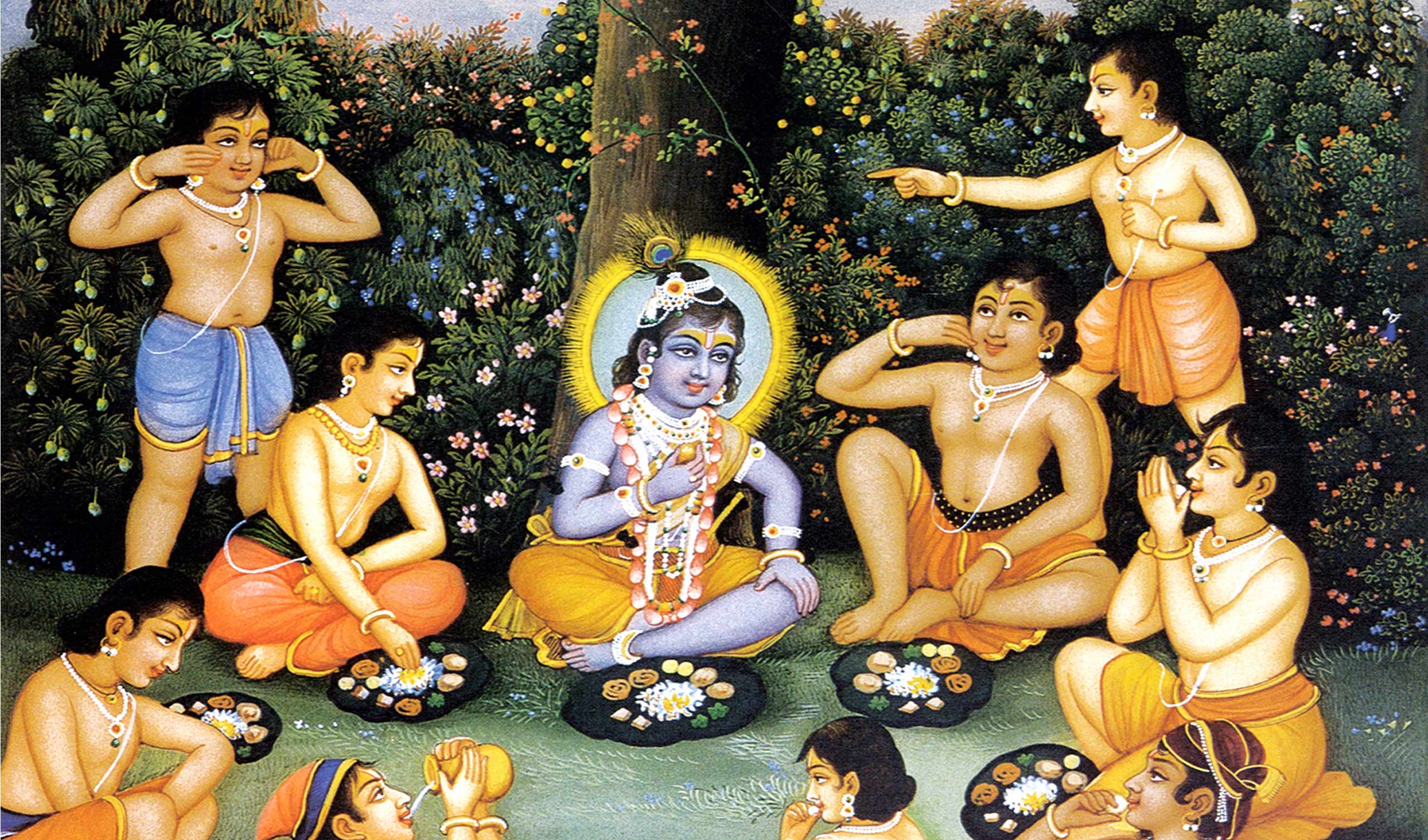
In the Vedic tradition, many people make prayers and offer food to God before eating. The food is cooked with the consciousness that it is for the pleasure of God and not for the sole purpose of gratifying our taste buds. A portion of the food items is then put in a plate and a verbal or mental prayer is made for the Lord to come and eat it. After the offering, the food on the plate is considered prasād and is accepted as God’s grace.
Shree Krishna stated in the 13th Verse of Bhagavad Gita, Chapter 3:
यज्ञशिष्टाशिन: सन्तो मुच्यन्ते सर्वकिल्बिषै: |
भुञ्जते ते त्वघं पापा ये पचन्त्यात्मकारणात् ||
yajña-śhiṣhṭāśhinaḥ santo muchyante sarva-kilbiṣhaiḥ
bhuñjate te tvaghaṁ pāpā ye pachantyātma-kāraṇāt
The spiritually-minded, who eat food that is first offered in sacrifice, are released from all kinds of sin. Others, who cook food for their own enjoyment, verily eat only sin.
Other religious traditions follow similar customs. Christianity has the sacrament of the Eucharist, where bread and wine are consecrated and then partaken. It is simple, whatever we eat has to be first offered to God. Eating food offered to God changes our consciousness. It not only nourishes the body it also nourishes our soul.
The question may arise whether we can offer non-vegetarian items to God and then accept the remnants as his prasād. The answer to this question is that the Vedas prescribe a vegetarian diet for humans, which includes grains, pulses and beans, vegetables, fruits, dairy products, etc.
Apart from the Vedic culture, many spiritually evolved souls in the history of all cultures around the world also rejected a non-vegetarian diet that makes the stomach a graveyard for animals. Even though many of them were born in meat-eating families, they gravitated to a vegetarian lifestyle as they advanced on the path of spirituality.
According to Leonardo da Vinci:
Truly man is the king of beasts, for his brutality exceeds them. We live by the death of others. We are burial places! I have since an early age abjured the use of meat…
In fact, in the Bhagavad Gita Shree Krishna goes a step further and states that even vegetation contains life, and if we eat it for our own sense enjoyment, we get bound in the karmic reactions of destroying life. However, if we eat food as remnants of sacrifice offered to God, then the consciousness changes. We then look at our body as the property of God, which has been put under our care for his service. And we partake of permitted food, as his grace, with the intention that it will nourish the body.
We understand how food affects our body but we often overlook its impact on the mind. Vedas say, what we eat is what our body and mind are made of.
Who Am I ?
Continuing our short series on ‘Who Am I’, let us now understand the characteristics of the soul. Scriptures talk about two types of characteristics; Svaroop and tatastha (marginal) characteristics. Svaroop means the natural characteristic of the soul. The soul is conscious; it is a power of God. At the same time, the Darshan Shastra as well as the Kenopanishad point out that the entity called ‘I’ is beyond the intellect, and as such, it cannot be understood by the intellect. The ‘I’ is beyond the grasp of the senses, the mind and the intellect since these are material and non-conscious.
Ved-Vyas says in Vishnu Puran that God has three main powers. The first is para shakti, the second is kshetrajna shakti (tatastha or marginal) and the third is called maya. Para shakti is God’s own personal power. It is also called as Svaroop shakti or Yogmaya shakti. God’s marginal power (tatashta) refers to the individual soul. God’s external power is called avidya, i.e. maya. What function does avidya perform? It creates the world. Maya includes God’s power ‘maya’ as well as the world. So, there are three powers – Yogmaya, Maya and the individual soul.
The individual soul is a fraction of God. It is the marginal power of God (tatastha shakti). What is the marginal characteristic of the soul? It is an eternal servant of God.
Lord Chaitanya Mahaprabhu says,
The soul’s true nature is God’s servitude
The Puranas, Shastras and God-realized saints say the same thing. The Vedas, the Shastras and the saints, say that there is a difference as well as a ‘non-difference’ between God and the individual soul. It is a very unique relationship indeed.
God is conscious, and so are we. From this point of view, we are equal to God. But there are differences between God and the individual soul. God is unlimited consciousness and we possess limited consciousness. In other words, God’s consciousness pervades everything, and our consciousness pervades only our own body. The soul pervades a small body; that of an ant, and it pervades a big body, that of an elephant. There is no body bigger than that. God is omnipresent; He is unlimited consciousness, and the individual soul is very small, very subtle.
How small is the soul? The very definition of the soul is that it is the smallest. Every Veda and Shastra says that the soul is so small that there is nothing smaller. Thus, God is unlimited consciousness and the soul is minute consciousness. This is a very big difference indeed. Let us look at the second difference. God is the controller; the individual soul is controlled.
Subscribe to:
Posts (Atom)